'They are almost second parents' – the Neonatal service awarded top accreditation
16.06.2026
Our Neonatal service has gained a top-level accreditation from a United Nations project aimed at giving babies the best start in life.
The Baby Friendly Initiative (BFI) is a global programme, developed in 1994 by UNICEF and the World Health Organisation. Originally, it promoted holistic care for families in the field of maternity care but now has expanded to involve all children services, including neonatal care since 2012.
“We are delighted that BCUHB has achieved full Baby Friendly status," said UNICEF UK Baby Friendly Initiative Deputy Programme Director, Anne Woods. “Our work to support breastfeeding is based on extensive and resounding evidence that breastfeeding saves lives, improves health and cuts costs in every country”.
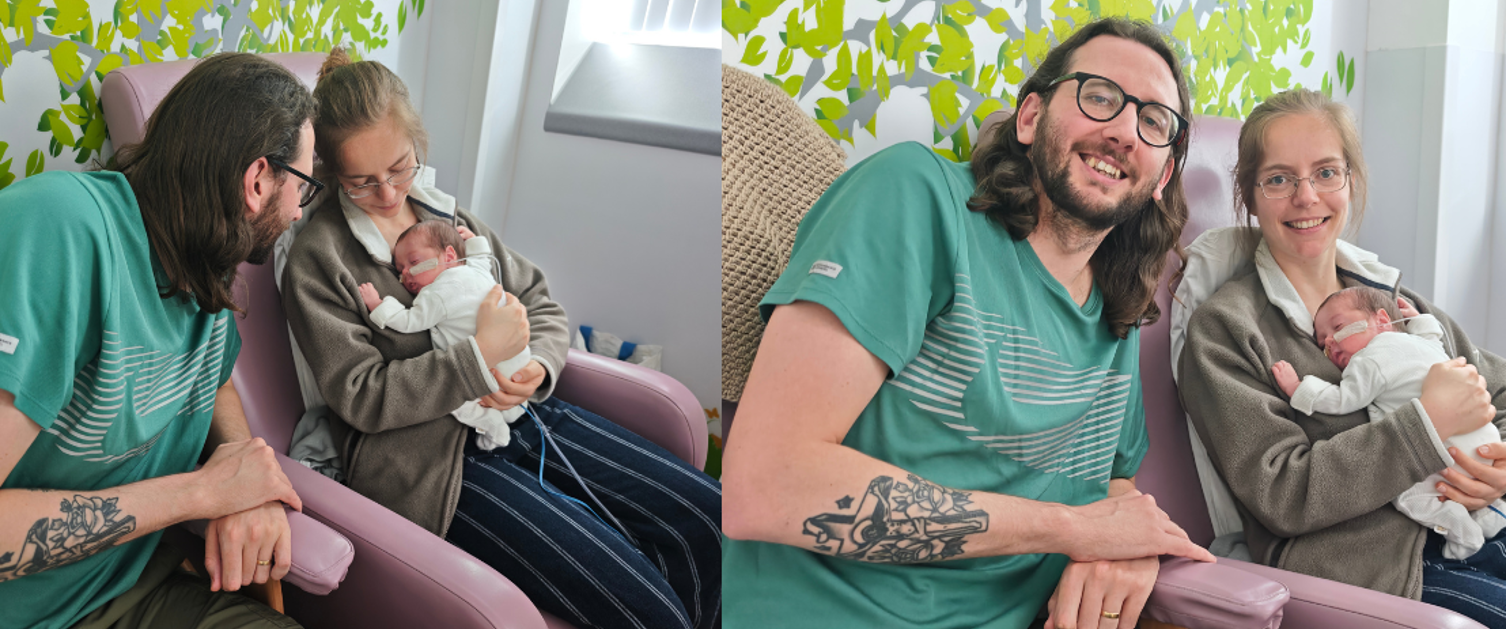
Ben Fleming and Amber Boekhorst, from Holywell, are one couple who have benefited from the advanced level of involvement, encouragement and care given by the Neonatal team at Glan Clwyd Hospital.
Their son Lukas was born unexpectedly at 27 +3 weeks, weighing just 1.16kg (a little more than 2.5lbs). At 37 +6 weeks, he had advanced to a healthy 3.2kg (more than 7lbs).
Lukas’s dad, Ben, said: “The staff have been incredible, spending 12 hours a day getting to know our baby. They are almost second parents – like a second family.”
Amber gave birth early after she had been rushed in to have her appendix removed. Initially, the family were in Arrowe Park Hospital, as she was training as a GP student doctor on the Wirral. After Lukas was transferred to North Wales, they saw the benefits of BFI swing into action.
“The nurses definitely advocate for us,” said Amber. “As soon as we got on the unit, they asked if I wanted to do skin to skin, which was really good. That’s what they've really promoted and told us that's the best thing that you can do as a parent for your baby.
“I think it's definitely contributed to his growth and his recovery. The long-term development, we are still to find out, but at least we've kind of given him the best start that he could have had.”
The Neonatal service across BCUHB was assessed in three stages by UNICEF, initially looking at policies and information in 2020, followed by interviews with medical and nursing staff assessing their knowledge in 2024 and finally ending in 2025 with an onsite assessment in each hospital with UNICEF Officers. The third and final stage was demonstrating to assessors that:
- parents were supported to have a close and loving relationship with their baby
- babies were encouraged to receive breastmilk and, where possible, breast feed
- parents were valued as partners in the hospital care of their children
Having received that final accreditation, the team has set a standard of care which gives neonatal babies and their parents the best environment in which to thrive.
Ben said: “All the meds are great, but actually him just lying on mum and dad is vital and it shows because he was at one point gaining 5, 6, 700 grams a week. They said his growth was ‘great, this is amazing’.”
Amber explained how being involved in ward rounds took fear and mystery away from being in hospital with a vulnerable child.
“I think there is that space to ask questions and even if the ward round has happened, we can ask questions for them to then come back and answer them,” she said. “The nurses have been invaluable and they've got a lot of knowledge. So do the other members of the team, like the physio, the dietitian. I think the wider team plays such a big part as well.”
Ben added: “We’ve had confidence because he has this full team around him, not just one consultant who looks at the medical part. He's got a dietitian in the background looking at growth and making sure he's doing the right things. He's got a physiotherapist for everything - the positions he's been put in. There's a psychologist on the ward, which is amazing, just to talk to and understand.”
Julie Grocott, Senior Staff Nurse and Neonatal Infant Feeding Lead on the unit, said: “This award is a reflection of our ongoing commitment to value the part parents play in their baby’s recovery.
“We embrace them as team members, giving research-based information of the benefits and normality of breastfeeding, supporting them to build strong family/baby relationships.
“Breastfeeding protects babies against a wide range of serious illnesses, including gastroenteritis and respiratory infections in infancy, as well as cardiovascular disease, asthma, diabetes and obesity later in life. We also know breastfeeding reduces the mother’s risk of some cancers and supports the mental health of both mother and baby.
“We set out to ensure all mothers and babies are supported to form a close and loving relationship – whatever their choice of feeding method – as this is the best start for every baby.
“Amber and Ben have done brilliantly and really embraced what we try to do here. Lukas is a lovely little boy and he’s done really well. We’re all so happy he is ready to go home with his mum and dad.”
Ben and Amber have had a planning to go home meeting. They said they will leave with confidence because of all the wraparound support and advice they have had.
Amber added: “The transition to the nursery's helped as well, because here the staff are even more hands-off. Since we've moved here, we've really felt like his parents. We’re the ones that are fully in charge.”
She does have one regret though: “I think we’re just going to miss out on the music therapy.”
We have launched our official WhatsApp channel to bring the latest Health Board news, updates, events and important information in your local area. Follow us here: Follow us on WhatsApp - Betsi Cadwaladr University Health Board