Wrexham resident backs new Wales breath test trial for cancer that killed her mum
27.08.26
A Wrexham resident, whose mum died just 12 weeks after a pancreatic cancer diagnosis, is sharing her story to support Wrexham Maelor Hospital trialling a world-first breath test for the disease, opening in the city today (27th August 2026).
Now hundreds of people residing in Wales suspected of having the disease will help scientists to confirm whether the breath test, which uses a breathalyser-like device, can detect the disease even in its earliest stages. Louise Dale, from the village of Gresford, hopes the test could spare thousands of other families the pain of losing someone like her mum in the future.
The site at Wrexham Maelor Hospital is part of a UK-wide clinical trial that will involve over 6,000 participants with an unknown diagnosis.
Charity, Pancreatic Cancer UK has invested more than £1.1M into this multi-centre trial, typically the final step before applying for regulatory approval, and then seeking adoption by the NHS. The charity believes the test, developed at Imperial College London, “could be the most significant step toward a lifesaving-breakthrough in 50 years”.
Duncan Stewart, Consultant Surgeon at Betsi Cadwaladr University Health Board, said: "We are proud that our research facility in Wrexham is the first site outside England to take part in this landmark study. Through this research, patients from North Wales will play a vital role in helping to evaluate an innovative breath test which has the potential to support earlier diagnosis in the future. While further research is needed, this study represents an exciting step forward and highlights the importance of clinical research in bringing new diagnostic technologies closer to patients.”
Professor George Hanna leads the team of Imperial College London scientists, who are hopeful that the test could be used by GPs across the country within the next five years. In an earlier two-year clinical study, they analysed over 700 breath samples from people with and without pancreatic cancer, as well as from those with other conditions affecting the pancreas. Initial findings suggest the test can already detect pancreatic cancer with a high degree of accuracy – even when the disease is at an early stage.
Louise’s mum, Carol Purchase, was diagnosed with pancreatic cancer in March 2024 and died just 12 weeks later, aged 69, eight days before her 70th Birthday. Carol had issues with indigestion and stomach pain in the year leading to her diagnosis, but it was attributed to stress. Before long, her appetite changed, and she began to lose weight rapidly.
Carol was sent for several tests which all came back inconclusive. Eventually, an ultrasound led to a CT scan referral, but it was booked three weeks later. In severe pain, Carol couldn’t wait —her family paid for a private CT scan, which revealed pancreatic cancer. Carol remained hopeful she’d be able to tolerate chemotherapy to gain more time with her loved ones. She managed one round but became too unwell to continue and Carol passed away.
Louise said: “Losing my mum so quickly to pancreatic cancer changed our family forever. As someone from Wrexham who knows how devastating the disease is, it means so much to know our community is helping to improve the future for other families who face it.”
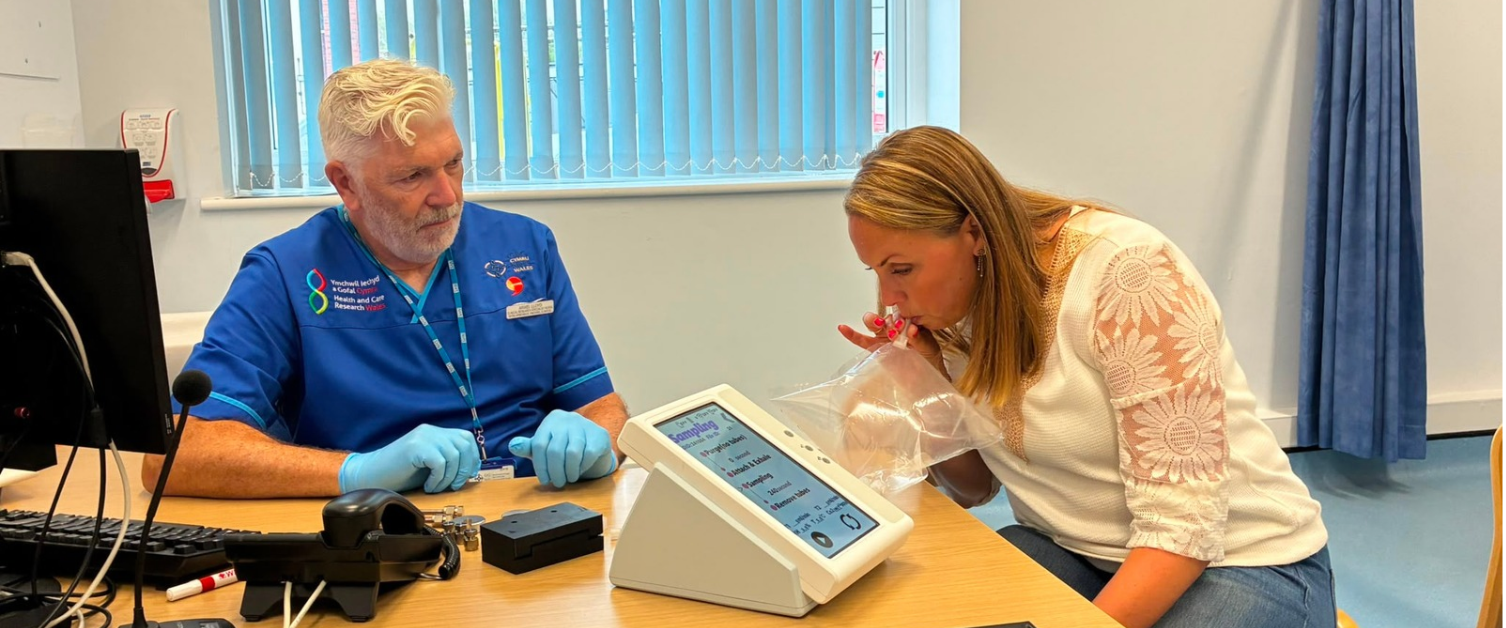
Around 529 people in Wales are diagnosed with pancreatic cancer each year and no screening or early detection tests currently exist to help doctors. GPs who suspect pancreatic cancer can request imaging tests or refer patients to the hospital for further investigations. However, the disease’s vague symptoms mean it’s extremely challenging for healthcare professionals to decide who should be referred for further investigation, who can be monitored or reassured. In future, simply breathing into a bag at a GP appointment could be the vital first step in getting more people diagnosed in time for surgery, currently the only potential cure for pancreatic cancer.
Louise said: “Mum would be incredibly proud that Wrexham is the first hospital outside England to take part in this trial. I believe she would have welcomed the chance to participate if it had been available when her symptoms began, especially knowing it could help other people in the future.”
The breath test works by detecting volatile organic compounds (VOCs) in the breath. Thousands of these compounds travel around the bloodstream, are filtered out when the blood reaches the lungs, and then exhaled. Patients with cancer produce different types of compounds, and these changes are detectable in the breath, even at the early stages of disease. Isolating unique combinations of VOCs should enable doctors to quickly identify the people likely to have pancreatic cancer who need to be triaged for urgent investigation.
The test is designed to be accurate, non-invasive, and usable in a GP surgery or pharmacy, and could have a significant impact by streamlining referral pathways while remaining cost-effective for the NHS. Breath samples can be taken in as little as 30 seconds, and scientists believe it could be possible to provide GPs with the test results within just three days. This would enable patients most at risk to be referred quickly for scans to diagnose or rule-out pancreatic cancer.
Diana Jupp, CEO of Pancreatic Cancer UK, said: “The breath test has the potential to revolutionise the early detection of pancreatic cancer, and it is hugely exciting to see this vital clinical trial expand into Wales.
“While more years of development are still needed, local patients with an unknown diagnosis will now help refine the breath test in the real world. They will take us ever closer to a future in which simply blowing into a bag at a GP surgery could help save thousands of people every year from the deadliest common cancer.”
Professor George Hanna’s ultimate aim is to develop a pan-cancer breath test, which could be used to detect and distinguish between several different gastrointestinal cancers, increasing the likelihood of adoption by healthcare systems around the world. Early work has shown it is possible to identify unique combinations of breath VOCs for oesophageal, gastric, liver and colorectal cancer as well as pancreatic cancer.
Professor George Hanna, Head of the Department of Surgery and Cancer at Imperial College London, said: “If our findings from the initial phase can be validated in participants with an unknown diagnosis, the breath test has huge potential to influence clinical practice and improve pancreatic cancer diagnosis.”